
- Faculty in charge
- Prof. Jay Dhariwal
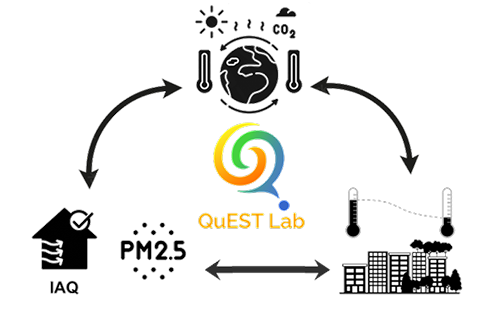
The quest of our research lab is to design solutions for Quality of Life Enhancement using Science (Design Science, Architectural Science, Social Science, etc.) and Technology and therefore the name ‘QuEST’ Lab :). We are currently working on understanding the nexus between air quality (outdoors and indoors), thermal discomfort due to heat stress (outdoors and indoors) and energy sustainability. The present research directions are about developing low cost sensor networks for ambient air pollution monitoring, spatio-temporal understanding of indoor air quality, learnings from the communities living a low carbon lifestyle, Urban Heat Island Effect assessment using remote sensing, passive solar techniques for low energy cooling and novel methods of bottom up environmental education.

Our lab is also fortunate to be able to forge synergistic research collaborations with faculty within the department (Prof Pramod Khadilkar working in Behavioral Design for Energy Sustainability), at other departments of IIT Delhi (Prof Seshan Srirangarajan from Dept of Electrical Engg working in wireless sensor networks and environmental sustainability; Prof Narsing Kumar Jha from Dept of Applied Mechanics with interests in experimental fluids and ventilation; Prof Vikram Singh from Dept of Chemical Engg with interests in understanding bioaerosols for mitigating infectious disease transmission; Prof Mahuya Bandyopadhyay from Dept of Humanities and Social Sciences with interests in imagining humane environments in confined spaces; Prof Dinesh Kalyanasundaram from Centre for Biomedical Engg with interests in medical device design and development) and in the rest of the country (Prof Anant Mohan, Prof Karan Madan, Prof Ravi Mittal, Prof Nishkarsh Gupta, Prof Nishant Verma and teams from AIIMS, Delhi with interests in medical device R&D).
Dr Delfina Fantini van Ditmar from the School of Design, Royal College of Art, UK (RCA has been consistently ranked 1st as per Art and Design QS rankings) visited IIT Delhi in January 2023 and was quite impressed by the research directions taken at the QuEST lab. She also gave an inspiring talk to the department community about designing ecological futures.
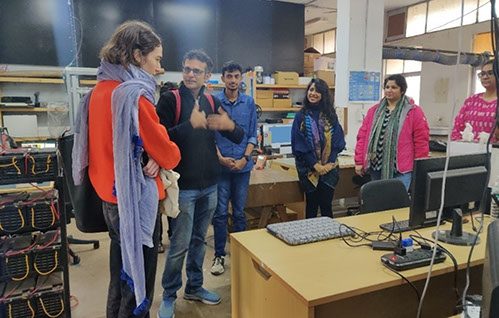
Dr Delfina from RCA, UK interacting with the QuEST Lab
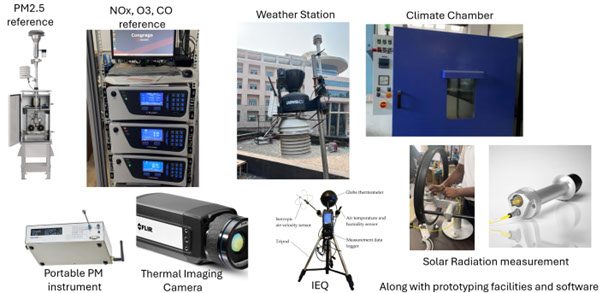
Thanks to the IoE grant of INR 2 crores, our lab has reference equipment for measurement of PM2.5, gaseous pollutants, indoor environment quality, solar radiation, weather station, FLIR thermal imaging and Photron high speed cameras, electro-mechanical prototyping facilities and software for CFD, BOS & GIS, which help us to work towards our quest to improve the environmental health and wellness.
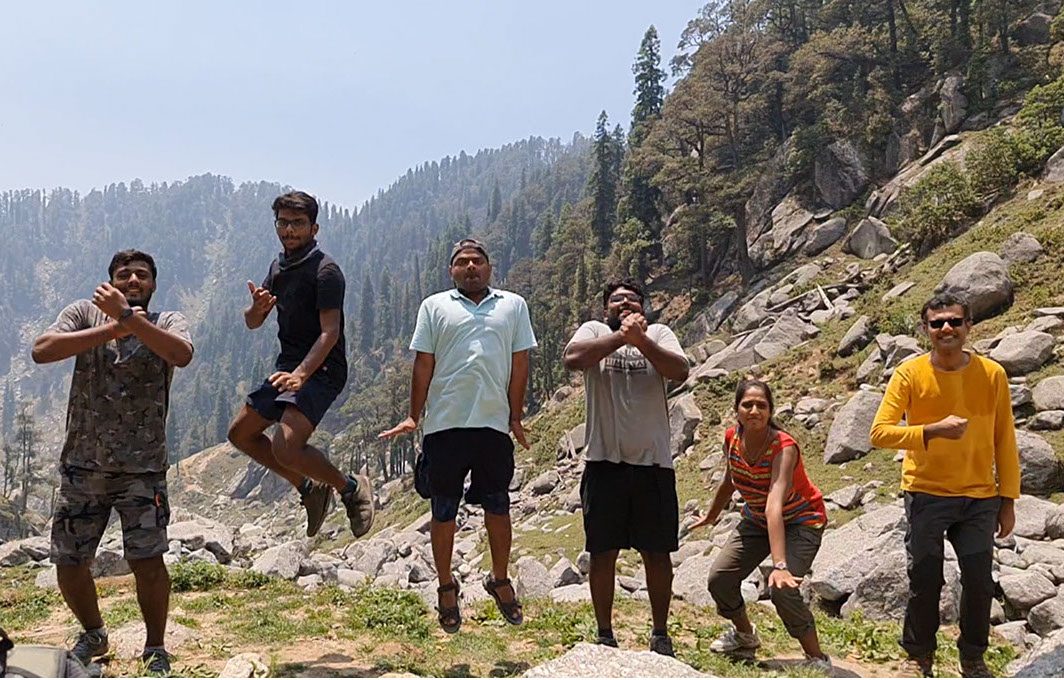
At present, we have a total of 9 PhD students and 1 research scholar in our research group from diverse educational backgrounds (ranging from energy sciences, sustainable architecture, mechanical sciences, cognitive sciences, electronics and physics) and different parts of the country. One of the highlights of our research group has been a multi-day summer trek which everyone absolutely loves 😀and it strengthens our resolve to work in the domain of environmental sustainability.
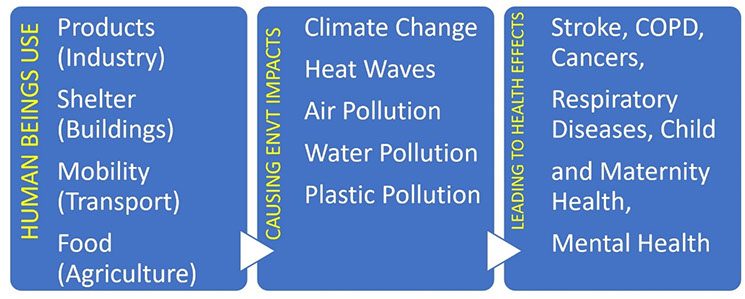
Every aspect of human lives from products, shelter, mobility and food contributes to environmental impacts, which is in turn affecting our health and wellbeing. The path to reaching net zero within the stipulated timeframe of the next 2-3 decades looks difficult and we keep wondering about how to make this transition happen for the world at the earliest. We would need breakthroughs in the research which needs to be deployed at scale in the world to make it happen.
Our lab would strive to implement novel methods of demystifying climate education to reach out to the masses for bottom-up environmental solutions. The curriculum to achieve this goal would consist of Life Cycle Assessment (LCA) methodology to compute the cradle to grave environmental impact for the lifecycle of the product, building or a lifestyle; energy balance to connect the micro level interventions with the impact at the country or the world scale; environmental health and wellness module to use experimental tools to relate environmental exposure to health effects and energy economics to compare the financial viability of the base case with alternatives. Using bootcamps, competitions and courses to let the students immerse in the real world settings while they also consider the health and financial impact of the solutions would help us tackle environmental challenges in a much better fashion. The heart of our pedagogy lies in developing empathy in our students towards real world problem solving, experiential learning, learning by doing and project based learning. We would like to take advantage of the department’s strength of taking a holistic approach to solving wicked problems involving socio-technical systems.
We recently also played a lead role in conducting a Change Makers summer bootcamp at IIT Delhi on the theme of environmental sustainability from 9th June till 27th June 2025, where we hosted 108 bright high schoolers and college freshmen for 3 weeks in a hybrid mode (online for 2 weeks and one week at IIT Delhi) who received valuable guidance from IIT Delhi faculty and student mentors and used state-of-the-art facilities available at the various labs of IIT Delhi including the Makerspace (a DIY Central Research Facility at IIT Delhi) to convert their impactful ideas to reality.